
Tinkering with Nearly 50 Years of Engineering
Business and Industry | Lion VoicesJuly 07, 2026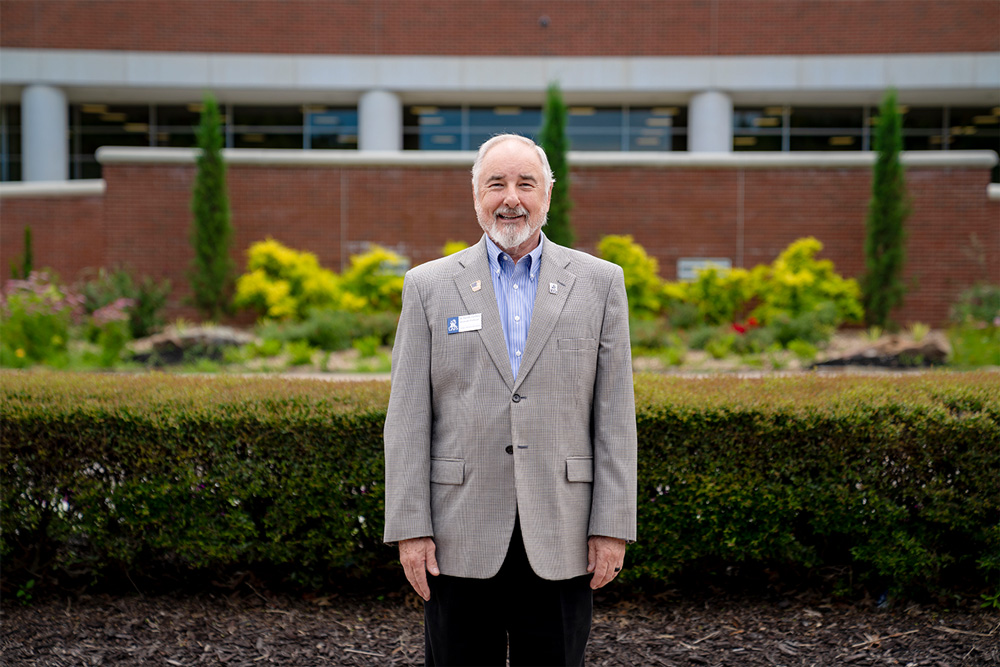
Dr. Randle Overbey. Courtesy Jacob Howell.
Share on Social Media


Current News Stories
Written By: Ian Silvester
After more than 20 years working as an engineer in the natural gas industry, Dr. Randle Overbey traded in his career for the one he had always desired: Educating others.
“I always thought that teaching was what I wanted to do and that was not the direction I went in my early career,” he said. “When I got the chance, I tried it as an adjunct for a number of years and absolutely loved it. Then I thought, if I ever get the chance to do this full time, I am going to take it and do it.”
Overbey was a first-generation college student when he attended Arkansas State, where he earned his bachelor’s degree in physics in 1975. It was there his passion for teaching began to bloom.
“It was just a very close-knit department, and I could tell that (the professors) both loved teaching and doing what they did. It inspired me,” he said.
By 1986, Overbey had both his master’s degree (1978) and Ph.D. in applied science, focusing on instrumentation and measurement techniques, from the University of Arkansas, Fayetteville.
Armed with his education and experience as an engineer, plus his wish to teach, Overbey came to the University of Arkansas – Fort Smith, then Westark Community College, in 1988. He taught engineering physics and physical science classes in the evenings. He did this through the end of the 1996 academic year, then returned to his role as an instrumentation engineer until 2000. That’s when the opportunity to teach full-time presented itself.
“I was really, really thrilled to get to join (Westark) at that time,” he said. “It was the opportune place, and the electronics technology program fit in really well with my background in instrumentation; it was just a natural fit.”
Over the course of 19 years, Overbey witnessed the change of Westark College to UAFS and adapted to changes in electronics and electrical engineering technology. He has been able to challenge both Western Arkansas Technical Center (WATC) and UAFS students to apply classroom instruction to the equipment they would one day operate.
“Demonstrating the theory behind things but then moving to the lab and then re-emphasizing that theory where they can actually see what’s happening,” he said is his teaching philosophy.
“We talk about varying frequencies and what this means, but when you can go see it on the hardware, and I have them vary the frequency and turn that knob, they can see on an oscilloscope the frequency change. So, talking about that theory and letting them see it and put their hands on it is really great.”
Overbey retired from teaching in 2019. He and his wife spent the next four years traveling around the country in their RV. Always the engineer, Overbey filled his time reading about the industry and working on efficient improvements around their home.
“Having the engineer in me, I’m always tinkering with things around the house and modifying and changing things here and there to improve it,” he said with a laugh.
But the itch to teach just hadn’t been fully scratched.
“I thought maybe I should teach some part-time because I really missed that. I missed the students,” he said.
Overbey returned to UAFS full-time in the spring of 2026 as an associate professor, once again teaching both WATC students at PEAK Innovation Center and electronics/electrical engineering technology students at the university.
“I’m just absolutely thrilled to be back at UAFS,” he said. “It has been amazing to see the growth in the program, the changes that have been made, and how the changes in the program have really caused it to grow and improve with the grants and additional money that’s come in. The equipment is state-of-the-art, and it’s a pleasure to work on. The students are learning on modern equipment and just doing wonderfully.”
In the fall, Overbey will again split his time working with WATC students at PEAK and students on the main campus. He has added program lead of electronics technology to his title. He has a particular interest in educating WATC students, saying teaching this field to a younger group of students helps it stick with them longer.
“It’s wonderful to watch, and it’s really fun to be a part of it,” he said. “It gives you a good feeling inside to know that you have helped them find that lightbulb moment.”
Media Relations
The UAFS Office of Communications fields all media inquiries for the university. Email Rachel.Putman@uafs.edu for more information.
Send%20an%20EmailRachel Rodemann Putman
- Director of Strategic Communications
- 479-788-7132
- rachel.putman@uafs.edu