
Share on Social Media


Current News Stories
Written By: Ian Silvester
It wasn’t quite to the moon or even leaving Earth’s atmosphere, but Hudson Reeves and three other University of Arkansas – Fort Smith students spent their summer doing the next best thing: Interning for NASA.
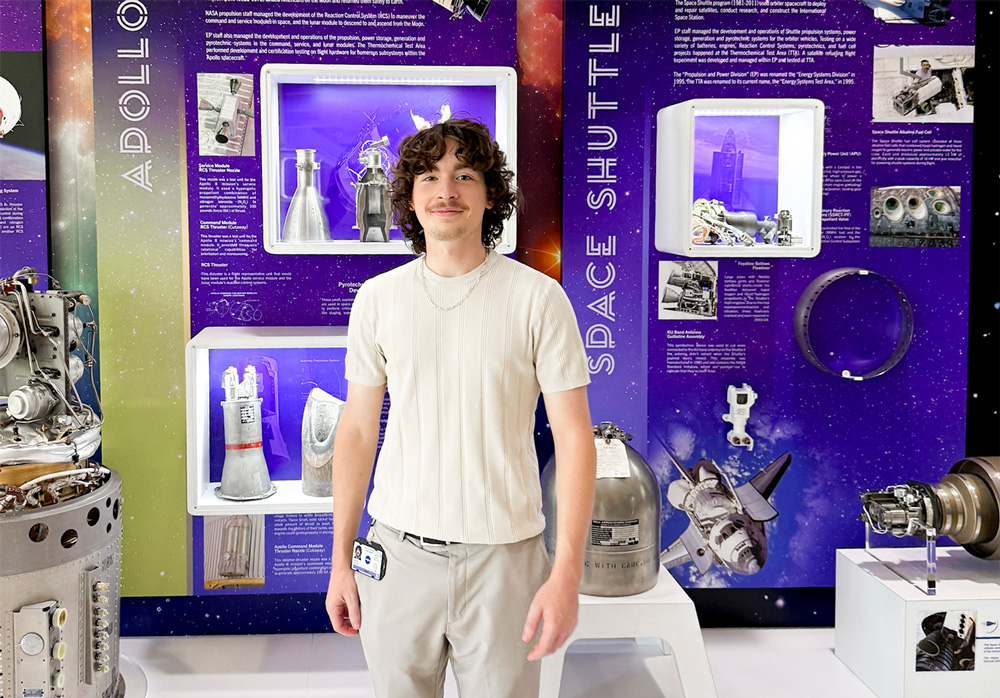
Hudson, a junior electrical engineering major, returned to campus this week after having spent 10 weeks at NASA’s Johnson Space Center in Texas. At JSC, Hudson was part of the ER7 simulation team, coding and running simulations for projects like the Artemis missions, rovers, and reentry splashdowns.
“The simulation framework at Johnson Space Center is called trick. It’s an open source, meaning anyone can have access to it and look at the code for it and make changes to it,” he explained. “My task as an intern was to create example simulations of the trick framework working with Unreal Engine, which is a game engine usually made for making games, but it’s also really nice for doing high-fidelity graphics. So, the trick simulation did the deep computations and all the calculations, and we sent the information to the visualization, which is Unreal Engine.”
Hudson said that as a child, he dreamed of visiting space as an astronaut, so the opportunity to work for NASA felt surreal.
“A goal I had for my bachelor’s was to get an internship at NASA. I was lucky to be in the position where I had a couple of offers and was able to choose between Johnson Space Center and Huntsville, Alabama,” Hudson said, noting the NASA Marshall Space Flight Center where two other UAFS students interned.
At UAFS, Hudson is part of the Autonomous Vehicle Challenge team where he codes much of the programming for their project. He said he believes this was a major factor in why he was one of the roughly 200 interns selected from all over the country—most of whom he said were either entering their final year of undergraduate studies or working on their postgrad—to work at JSC this summer.
In fact, his coding experience is what landed Hudson the opportunity to do more than his mentor initially planned for.
“I was able to contribute some code both public and internal to NASA. I got to modify what’s called TUC, which is trick Unreal Connector. It’s the pipeline between trick and Unreal that is used in the example simulations, and I got to add its ability to use rotation matrices. I also got to write a how-to guide that is on NASA’s trick documentation. It’s public, so you can go on it from any web page for how to connect up simulations to Unreal Engine,” he said.
He said one of the coolest parts of the job was right outside his office window. While working on these simulations, if Hudson looked out his window, he had a perfect view of Mission Control.
Despite working on complex code and sitting in an office where an engineer who worked on the Apollo missions may have once sat, Hudson joked that the hardest part of the experience was outside of work.
“This was my first time really living away from home,” he said. “I was pretty well prepared, but the only thing was just trying to figure out what to cook.”
While working, Hudson said there were moments when he had to pinch himself when thinking about the work he was doing and the other interns. As a first-generation student, he said it was easy to feel like he didn’t belong.
“I definitely had imposter syndrome because the intern near me was finishing up his Ph.D. So, it’s like, I’m talking to this guy as my peer, but he’s much older than me, and he’s much more educated than me,” Hudson said.
He didn’t let that stop him from working hard to prove to himself and his NASA mentor that he was capable of the work.
“Some of these interns came from Ivy Leagues, but I quickly realized that it actually didn’t matter. In the beginning, I felt out of place, like these people would be so much smarter than me, but then I realized that actually wasn’t the case at all,” he said. “I felt very capable in what I was doing, and I was prepared for everything I did.”
At JSC, Hudson was joined by a fellow UAFS student, Beau Sampley. Two others, Evan Quirk and Jonah White, interned in Huntsville, Ala., at the NASA Marshall Space Flight Center.
Media Relations
The UAFS Office of Communications fields all media inquiries for the university. Email Rachel.Putman@uafs.edu for more information.
Send%20an%20EmailRachel Rodemann Putman
- Director of Strategic Communications
- 479-788-7132
- rachel.putman@uafs.edu