
Injury to Comeback: Brian O’Connor Leads UAFS Athletes Back in the Game
Athletics | Lion VoicesJuly 07, 2026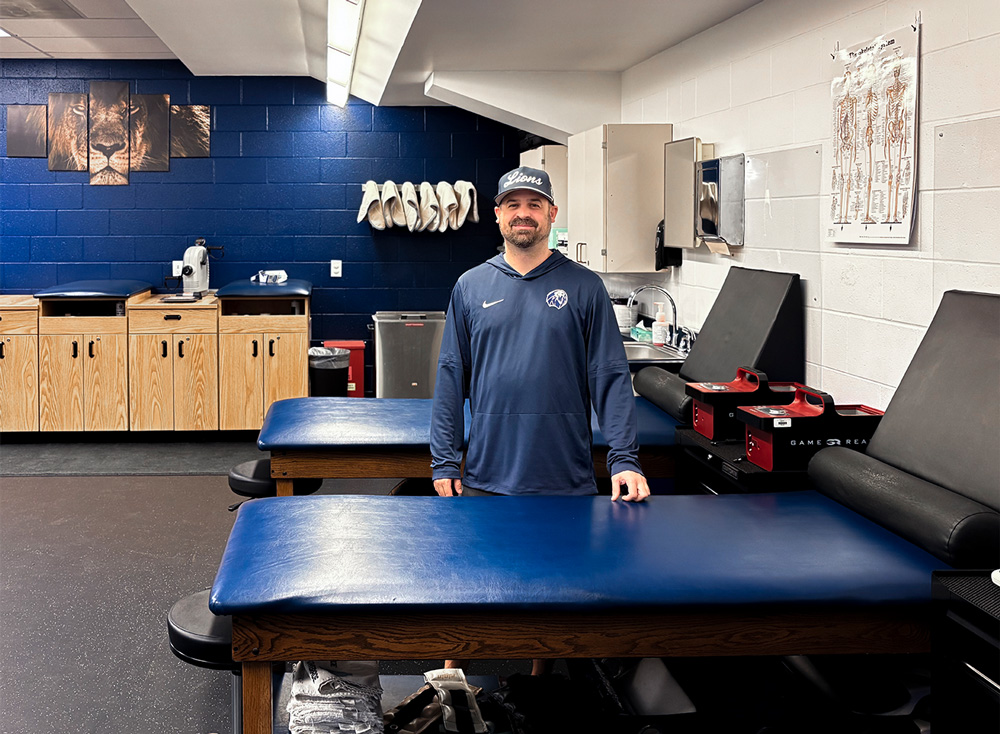
Brian O'Connor
Share on Social Media


Current News Stories
Written By: Ian Silvester
The fabric of athletics is fast-paced, intense, and sewn with raw emotion. Athletes are trained to get back up when they get knocked down. Still, cries of frustration or pain sometimes signal that they just can’t. In times like that, it’s the team behind the scenes that ensures athletes get back on their feet.
For 14 years, the man leading the behind-the-scenes team at the University of Arkansas – Fort Smith has been Brian O’Connor, director of sports medicine.
“The long-running joke in athletic training is that we tape ankles and hand out ice packs, but there’s more to it than those basics,” O’Connor said.
From the moment an student-athlete gets hurt to when they return from surgery, if one is needed, O’Connor and his staff are there for every step, he said. Their goal is to help every student-athlete who enters the athletic training room find a way back to the court or field at the same level they left it when injured.
He said the moment a player returns is worth all the effort put in by the student-athlete and by O’Connor and his staff. But not every return goes as planned.
“Timelines are timelines; they’re not set in stone. Just because the goal was to run at six weeks, it could be seven or eight weeks, and that’s okay. It doesn’t mean you did anything wrong; we all heal differently,” he said of the rehab process.
The key is to build up the small victories, O’Connor noted.
“That first day that they get to jog after a surgery, celebrating that, or hitting those check marks of progression and making sure they understand that it’s a long process. Sometimes you have a setback or two, and those are really hard days, but you’re also going to have those wins along the way,” he said.
Helping an student-athlete treat both the physical injury and the mental side effects that come along with it is paramount for O’Connor. A former student-athlete who experienced injuries himself, O’Connor understands the toll an injury takes when it forces a player to spend time away from the team.
“Their circles are kind of small because they have their team and their coaches, and that kind of becomes their friend circle. So, if they’re not practicing and they’re not playing games, they kind of lose that identity, and that can be really hard on them,” O’Connor said.
He said that even if it’s just the first 10 minutes of practice that a player can be with the team before getting back to work in the training room, it goes a long way toward helping them return to the game.
To help every student-athlete return to their respective teams, O’Connor employs his preferred methods of athletic training. He uses functional-based exercises to mimic the forces each player will feel on their specific injury as if they were playing. O’Connor also teaches them about their injury.
“I try to spend time, not just telling them things to do, but explaining why we’re doing it and explaining what their injury is. It’s easy to just say, ‘Well, you rolled your ankle,’ but to pull up a picture in a diagram and show them the muscles and tendons and ligaments so that they can visualize why it hurts, I think, is important for them to grasp what it is that’s injured,” he said. “I think that can help them understand the recovery process and why we’re doing what we’re doing.”
O’Connor said this is part of the evolution of athletic training away from the misconception that taping ankles and handing out ice packs is enough. Today, it’s about preventing, diagnosing, treating, evaluating, and rehabbing injuries.
O’Connor was inspired to pursue a career in sports medicine after his own athletic injuries and by seeing how much goes into getting a player back to full strength and keeping them playing. He received his bachelor’s degree in health and human performance from Iowa State University in 2009. While pursuing his master’s in higher education administration at the University of Nevada, he worked as a graduate assistant for the university's football team.
Although he loved his time working with student-athletes at the Division I level, UAFS has been the most fulfilling school at which to work, O’Connor said.
“The competitiveness that our teams have had over the years has made it fun to be around,” he said, proudly. “But also the people. We’ve had student-athletes from all over the United States and several different countries that I’ve been fortunate to interact with, which is very fulfilling to me.”
That competitiveness O’Connor touts wouldn’t be possible without him and his team working to keep student-athletes healthy and ready to compete every day. They are just as important to winning and success as coaching, schemes, and the talent on the court or field.
- Tags:
- Lion Voices
- UAFS Athletics
Media Relations
The UAFS Office of Communications fields all media inquiries for the university. Email Rachel.Putman@uafs.edu for more information.
Send%20an%20EmailRachel Rodemann Putman
- Director of Strategic Communications
- 479-788-7132
- rachel.putman@uafs.edu