
Tom Watkins Returns to the Classroom and Lessons That Shaped Him
Arts and Sciences | Community | FeaturedSeptember 15, 2026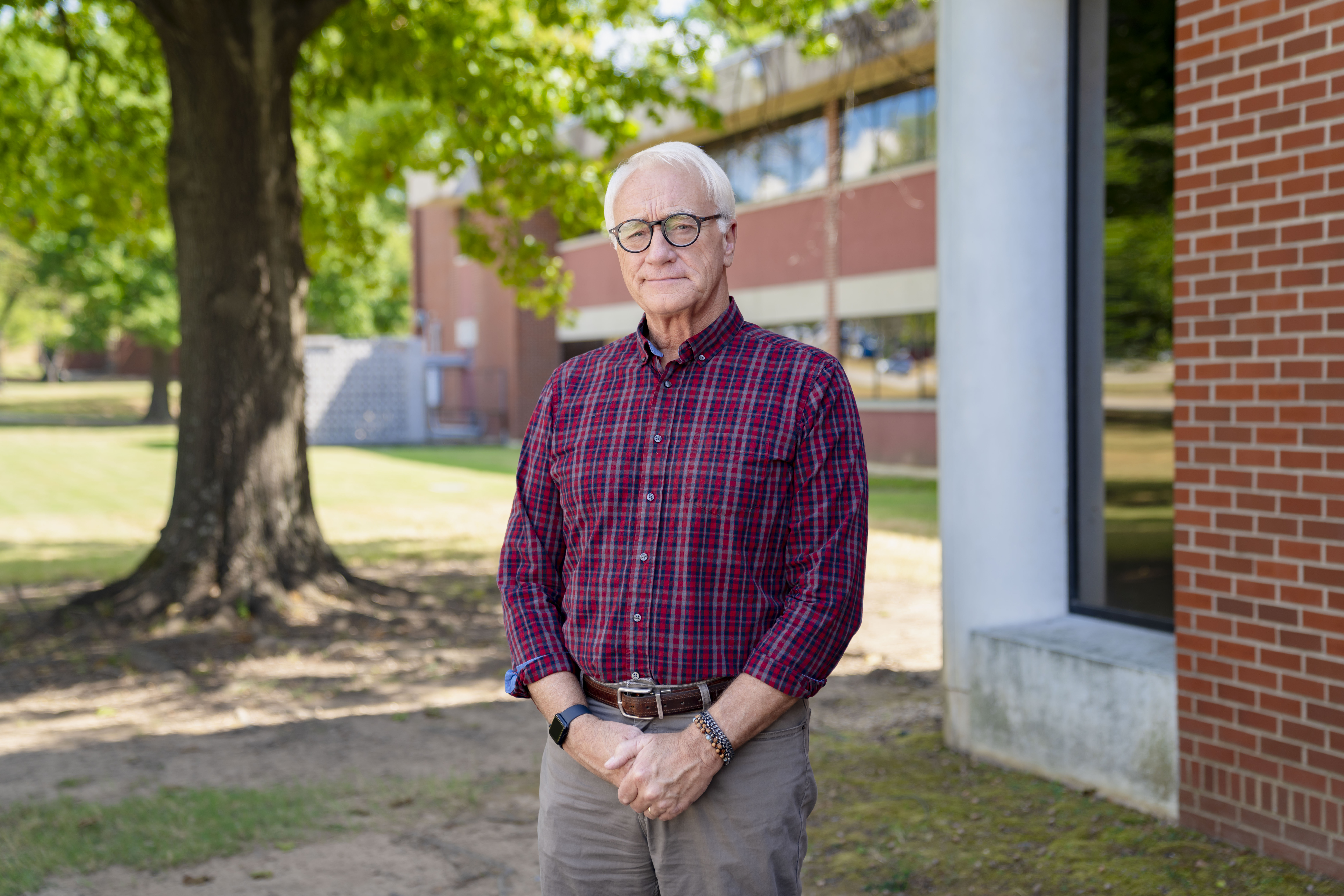
Tom Watkins returns to the classrooms where his own professional journey began to help teach and inspire future educators.
Share on Social Media


Current News Stories
Written By: Tina Alvey Dale
When Tom Watkins walks into the Flanders Building at the University of Arkansas – Fort Smith, it’s a bit like stepping back in time.
The building looks different now. So does much of the campus.
Still, when Watkins walks into a classroom, he can remember being a student in the old Science Building, sitting among more than 70 unfamiliar faces during his first class at Westark College.
“There were more people in that room than the number of approximately a third of my high school,” Watkins said. “It triggered a fight or flight response.”
The difference now, Watkins is on the other side of that classroom.
The history alum returned to UAFS in 2022, first teaching as an adjunct and now serving as an instructor of history. After more than 30 years away from consistent classroom teaching, he admitted he wasn't sure how well he would connect with students who were decades younger than him.
But returning to UAFS wasn’t simply a new chapter in his career. It was a return to a place that helped shape the educator he became.
When he attended Westark, the campus looked markedly different. The area that now includes the Bell Tower Commons and arboretum was a giant parking lot and the old Lions baseball field. The technical complex along Waldron Road consisted of a series of metal buildings that housed the trades programs. There were no residence halls, and the Holt Library and Vines Building that Watkins remembers are long gone.
There are things that stayed the same, though.
Walking into Fullerton Building in 2022 was particularly striking for him. Fullerton had been the student union when Watkins was a student. He remembers it as considerably more “boisterous” and less elegant than it is today.
And then there was Flanders.
Standing in the old science lecture hall, Watkins remembered the first moment he walked into a Westark classroom and the instructors who helped him find his way through college.
“There is a long list of Westark instructors who had such a major impact on my ability to succeed,” he said. “There are aspects of their instructional talent I have emulated during almost every phase of my career.”
That influence followed Watkins through a career that has included teaching, school administration, and work in fine arts education.
His years as an administrator with the Van Buren School District taught him to see education from a much wider perspective.
“It taught me to be aware of the holistic nature of a quality school,” he said. “It’s a big picture angle.”
Working with a staff of roughly 70 high school teachers sharpened his understanding of teamwork, communication, leadership and human relationships. Perhaps most importantly, it reinforced the value of honesty and transparency.
Those lessons now show up in his UAFS classroom.
Watkins makes a point of communicating his expectations and educational philosophy clearly, so students understand what success looks like and why those expectations matter.
“There are no surprises, no ambiguity—hopefully—and students always know how they can be successful in our work together,” he said.
He doesn't believe high standards should make students miserable.
“My message to them is that it should be an exciting, positive adventure,” Watkins said.
That approach seems fitting for someone who views teaching as much more than a job.
Earlier this year, Watkins received the Luella M. Krehbiel Adjunct Teaching Excellence Award, an honor he described as deeply meaningful because it came from both peers and students.
“I believe teaching is one of the ultimate human arts,” he said. “The ability to open new paths and doors to knowledge are some of the best gifts one can give to the future.”
Watkins works with students in the UAFS School of Education, including students preparing to become teachers. He has watched future educators develop and lead lessons in his methods class, and this year he is working with teacher residents as they complete their classroom experiences and prepare for certification.
He is particularly enthusiastic about the work being done to prepare UAFS teachers to be “Ready on Day One.”
“That is a tall order,” Watkins said. “But from my perspective as a veteran educator, they are doing all the right things to achieve that objective.”
His own path to becoming that veteran educator included some unexpected, and fun, detours.
In 1997, at age 37, Watkins picked up a practice chanter after receiving one as a Father's Day gift.
The practice chanter is the small instrument used to learn the fingering and notation before taking on the full Great Highland bagpipes. Watkins eventually connected online with Kenton Adler, a Fayetteville friend who was teaching at the University of Arkansas at the time. Adler invited him to a rehearsal for the Ozark Highlanders.
Watkins showed up.
He started at square one.
By the end of 1998, he was playing with a Grade IV band. By 2000, he had joined more experienced musicians in a Grade III band, competing and performing at Highland games in Arkansas, Oklahoma, and Missouri as well as parades, memorials, and community events.
The band performed at the biennial supporter's convocation for the School of the Ozarks in Branson, where Watkins had the opportunity to meet Colin Powell and Tony Orlando.
“I know, odd pairing,” he said with a laugh. “It was a real treat to get to meet and talk to those celebrities.”
Watkins eventually stepped away from the bagpipes after years of performing. But the experience left him with a lesson he still shares with students.
“If you have an interest and want to learn… go for it,” he said.
And music has remained part of Watkins’ life even after the bagpipes. He has sung in amateur theatrical productions and spent years as the executive director of the VBSD Fine Arts Center, coordinating band, choir and theater performances and helping produce high school musicals.
Still, his focus these days is the classroom. And perhaps the most important lesson he brings to that is one he learned through all of his roles: Knowledge matters most when it is used to help someone else.
“I believe we are created as humans to serve others and the real wealth that someone can accumulate in this life journey is found there,” he said.
Watkins doesn't claim to know everything. But he does believe his experience might be useful to someone else.
“I am willing to give that as a gift if they need it,” he said.
That philosophy brought Watkins back to the place where his own journey began.
The campus may have changed dramatically since his days as a Westark student. The buildings, programs, and landscapes are different.
But the fundamental opportunity remains the same, he said. A student walks into a classroom, unsure of what comes next, and encounters someone who might help open a door.
“I look forward to several more years of this work,” Watkins said.