
Second Chance Scientist
Arts and Sciences | Lion Voices | ResearchApril 13, 2026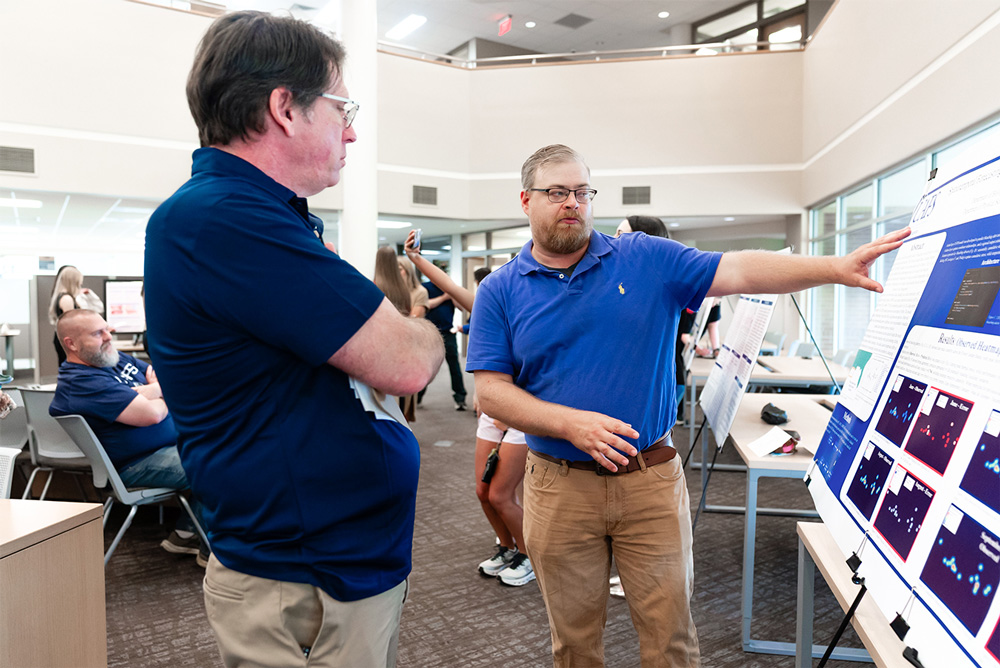
Christopher Edwards (center) shares his research at the 19th Annual Student Research Symposium. Courtesy Jacob Howell
Share on Social Media


Current News Stories
Written By: Ian Silvester
There was a time when Christopher Edwards wasn’t sure what his direction in life was. He had dropped out of classes at the University of Arkansas – Fort Smith a few years after enrolling in 2005. Then he found himself out of a job. A phone call and a chance run-in changed everything.
“One morning, I got a phone call from the Department of Education, and they said they saw that I qualified to get my student loans reset and asked if I’d be interested in going back to school,” he said. “I told them, ‘That sounds like an awesome opportunity.’”
Christopher returned to UAFS to finish what he started nearly 20 years before.
Having always enjoyed the water and wildlife, he set out to become a marine biologist and found a foundation for this new endeavor through the biology program at UAFS. Over the last three years, Christopher has honed in on the research he is most passionate about, and he credits a Maymester trip to Belize in 2023 as the catalyst.
“We visited the Belize barrier reef, and we noticed there was a lot of dead coral,” he recalled. “I returned to school and took it upon myself to research why and attack while living in Arkansas.”
Christopher began working with James Brandli, a biological science instructor, to collect water-quality data around Fort Smith to detect land-use pollution. They found the water not to be the best based on nutrient metrics. Some areas of the Arkansas River had salinity nearly as high as the marine level.
“All of this is going from the Arkansas River to the Mississippi River and to the Gulf of Mexico,” Christopher said.
Christopher began diving deeper into the data, essentially forming his own research project, when he bumped into Dr. Maurice “Moe” Testa, associate professor of physical sciences, one evening while grabbing dinner.
“He asked if I wanted to come with him to a conference, and when we finally sat down to review my abstract, that’s when he realized that I was doing this all by myself,” Christopher said with a laugh. “He stepped up to become my PI (principal investigator) and helped guide me on how to actually think like a scientist.”
Now paired with Testa, Christopher began using Artificial Intelligence to build a neural network model in Python to predict climate impacts, which might trigger coral-bleaching alerts based on seasonal trends, sea-surface temperature metrics, and thermal stress metrics.
Throughout 2025, Christopher and Edwards tested all 17 NOAA monitoring stations at the Flower Garden Banks National Marine Sanctuary in the northwestern Gulf of Mexico, where Christopher deployed his prediction model. The results showed a core-piercing correlation of 0.79, but when filtered to the active coral-reef sites, the correlation jumped to 0.94.
“During the month of August, we had extreme heat, and our model handled that heat and was actually able to predict nearly a 1.0 correlation,” Christopher said.
Coral bleaching is driven by climate change and ocean acidification. Christopher’s research is producing Bleaching Area Alert heat maps and time-series analyses to visualize spatial and temporal bleaching trends, giving reef managers actionable insight to anticipate bleaching events, guide monitoring efforts, and to overall protect these fragile ecosystems that have a large impact.
“Think of a rainforest being destroyed and the displacement of many of the organisms that live there because there are no adequate nutrients available. That’s essentially what’s happening here,” he said. “When reefs are under prolonged heat stress, it kills the coral, and it causes the fish to look elsewhere. At a large rate, that’s going to provide fewer ecosystems for fish to live in and, to a greater extent, fewer fish for fisherman to collect, impacting their livelihoods and the food they eat.”
Christopher presented his research, “Spatiotemporal Forecasting of 2025 Coral Bleaching Alerts at Flower Garden Banks National Marine Sanctuary,” at the 19th Annual Student Research Symposium at UAFS. In May, he will graduate with his bachelor’s degree before going to the University of Central Arkansas for graduate school.
He said coming back to UAFS provided him with an opportunity of a lifetime and helped him “learn how to be a scientist.”
After returning to school, scared even to think about pursuing graduate school because he thought he “isn’t smart enough,” Christopher is a shining example of how it’s never too late to follow a passion. He has found confidence in himself and hopes to one day return to Belize to help the country’s coral reefs thrive, thanks to the research he plans to continue conducting as he furthers his education.
Media Relations
The UAFS Office of Communications fields all media inquiries for the university. Email Rachel.Putman@uafs.edu for more information.
Send%20an%20EmailRachel Rodemann Putman
- Director of Strategic Communications
- 479-788-7132
- rachel.putman@uafs.edu