
Five Secure SURF Grants; Record for UAFS
Arts and Sciences | Bell Tower | Research | FeaturedDecember 10, 2025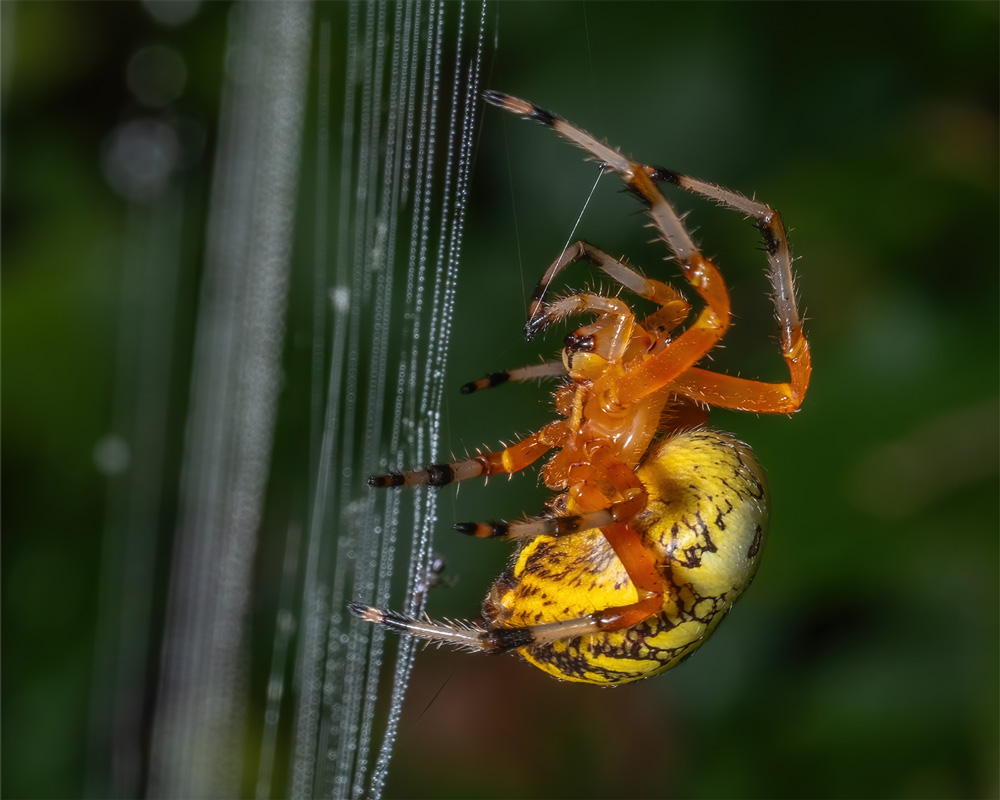
Marbled orb weaver spider
Share on Social Media


Current News Stories
Written By: Ian Silvester
Five students from the University of Arkansas – Fort Smith were recently awarded Student Undergraduate Research Fellowship (SURF) Grants by the Arkansas Division of Higher Education.
The designation was the third-highest total awarded to an Arkansas university, behind the University of Arkansas, Fayetteville, and the University of Arkansas at Little Rock. It was the most ever received by UAFS.
SURF Grants are awarded to STEM and non-STEM research categories. Four of the UAFS recipients were awarded for STEM projects; one was awarded for a non-STEM project.
“Student research can be found at the center of the UAFS mission,” said Taylor Martinez, director of research and sponsored programs. “These hands-on research opportunities enhance our students’ preparation for their future, whether that’s in the workforce or graduate education, through critical thinking, problem solving, and analytical skills.”
SURF focuses on continuing the development of undergraduate academic research at Arkansas’s public and private institutions of higher education and providing funding to encourage students to conduct in-depth research projects in specific fields of study under the tutelage of a tenured or full-time faculty member. Students are expected to present their research, providing them with additional hands-on experience.
The research fellowships are supported through the Arkansas Division of Higher Education. Awards can either be for the spring semester only or continue through the fall. Each student-mentor duo will receive $2,750, covering a stipend for the student, travel expenses for the student to present their research, and a small amount for the mentor's research costs.
Below is a list of the UAFS winners and a description of their research.
Willow McFerran, senior biology major (STEM)
Mentor: Dr. Chris Pierret
Project Title: Impact of a bioblitz on an individual’s perception of community and nature
Description: Studies have shown that technology has pushed people into more online spaces instead of third spaces, places where people gather outside of their home/work. These third spaces, such as parks, are crucial for connecting people to their community and environment and have been shown to improve mental well-being. It’s proposed to embed a research project to measure the effect of using green spaces to bring people together in a community-led event called a BioBlitz. Research aims to answer the question: “Will an activity that draws a community together with a focus on nature change their connectedness to that nature and to each other?” The research will be conducted through surveys, such as the Connectedness to Nature Scale and the Brief Sense of Community Scale. By involving schools, organizations, and the entire River Valley area, a broad range of data on these questions will be collected.
Isaac Teague, senior biology major (STEM)
Mentor: Dr. Jason Ortega
Project Title: Microplastic Abundance and Variation within Non-Web Building Spiders: Dolomedidae and Lycosidae
Description: Microplastics are a pollutant that has gained recent attention due to their potentially harmful effects on the environment, wildlife, and human health and well-being. While microplastics were initially discovered and studied in marine environments, recent studies suggest they are also present in terrestrial environments. Through the soil, food sources, and water cycle, organisms such as terrestrial arthropods incorporate these microplastics by ingestion of prey items and hydration sources, gas exchange, and adherence. The aim is to identify microplastic variation (type) and abundance (quantity) within terrestrial non-web building spiders across Fort Smith, Arkansas. Chemical techniques and Raman spectroscopy will be used to identify microplastic particle type, size, shape, and overall abundance. This study will advance scientific understanding of the types of microplastics being ingested along with their quantities. It will inform the health of the urban environment in which they are found. In addition to identifying microplastic microhabitat aggregation, these findings will help uncover the biomagnification of this pollutant throughout the life history of these arachnids.
Rawan Yasin, senior biology major (STEM)
Mentor: Dr. Sandya Baviskar
Project Title: Aggregation or Segregation: Exploring the Interactions Between Co-Occurring Species of Dictyostelids from Arkansas River Valley
Description: Dictyostelium are bacterial predators in forest soil and hence play an important role in soil microbiome and plant health. Therefore, there is a growing interest in studying the wild isolates of Dictyostelids. When food is available, Dictyostelids lead a solitary life. But when starved, approximately a hundred thousand amoebae aggregate to form a multicellular fruiting body with a base and stalk made of dead cells and a sorus containing live spores at the top. Because about 20% of starving amoebae self-sacrifice to become stalk to keep the remaining 80% live cells aloft, it is considered an example of altruism and cooperation. In natural populations, aggregations can form between starving amoebae of different species to form a chimeric fruiting body, which can lead to either cooperation where two different genotypes contribute proportionately to stalk and spore, or there can be a conflict where one species could be a cheater, producing mainly spores but under contributing to the sacrificial stalk. This gives the cheaters a reproductive advantage but undermines the cooperative effort. In fall 2024, three undergraduate research students isolated five Dictyostelid species from the Arkansas River Valley. Using DNA-based approaches, the genus and species of these isolates were identified. Since these wild isolates were found from the same habitat and some from the same one-gram soil sample, it is important to determine whether these co-occurring, but genetically distinct, isolates aggregate to form chimeric fruiting bodies or segregate when mixed in equal proportions. The findings of the study will provide insights into Dictyostelium’s morphological diversity, reproductive and evolutionary strategies, and social behavior, which will subsequently facilitate soil functional studies.
Shelby Zink, senior biology major (STEM)
Mentor: Dr. Jason Ortega
Project Title: Investigating Microplastic Pollution Patterns in Web-Using Arachnids (Araneidae and Tetragnathidae)
Description: Microplastic (MP) pollution poses a global threat to human health, wildlife, and the environment. Research on aquatic MP detection has grown, while reliable methods for sampling airborne MPs remain underdeveloped and inconsistent across scientific literature. Recent work indicates that spider webs can serve as effective natural assays for airborne MPs and could potentially be used to monitor MPs in terrestrial areas. This study aims to validate and expand recent methodology by examining MP patterns in webs across Fort Smith, Arkansas. Chemical techniques and Raman spectroscopy will be used to identify particle load, type, and size. The study will advance the knowledge of airborne MP distribution and reveal the biological implications of this widespread pollutant. Beyond identifying zones of contamination, this work will provide critical insight into how urbanization impacts the life history of arachnid species. The results will aid in the development of accurate airborne monitoring methods and create a framework for future pollution studies.
Lane Metcalf, senior history major with teacher licensure (Non-STEM)
Mentor: Dr. Jennifer Shure
Project Title: Teacher Perspectives on Effective Interventions and Therapies for Students with Diverse Support Needs
Description: This study investigates the relationship between interventions and shifts in the academic achievement and well-being of students who require diverse support needs. The results of this study will reveal the perspectives of teachers who have assisted this specific group of students and collaborated with interventionists and therapists in their work with these students. Surveys will be distributed across several districts in a region in Arkansas, combining Likert-scale and open-ended questions to capture both measurable trends and personal reflections. This mixed-methods approach provides a clearer understanding of interventions in real classrooms and how teachers experience and evaluate their impact. While prior research has examined the programmatic outcomes of individual therapies, few studies have focused on teachers’ lived experiences in implementing these supports. This project builds on earlier work, including Bekirogullari’s (2018) Cognitive Behavioral Therapy in Treating Persons with Learning Disabilities and Sandberg, Norling, and Lillvist’s (2009) Teachers’ View of Educational Support to Children in Need of Special Support, extending that discussion to public schools in Arkansas. Open-ended responses will be thematically analyzed to identify recurring patterns, including perceived barriers, collaboration with therapists, and the impact of interventions on student growth and well-being.
Media Relations
The UAFS Office of Communications fields all media inquiries for the university. Email Rachel.Putman@uafs.edu for more information.
Send%20an%20EmailRachel Rodemann Putman
- Director of Strategic Communications
- 479-788-7132
- rachel.putman@uafs.edu